Building an off-grid cabin in Canada involves decisions that differ substantially from conventional residential construction. The absence of utility connections, the variability of seasonal access, and the range of permafrost and soil conditions across the country's geographic zones all push builders toward site-specific solutions rather than standard residential specifications.
This article covers what field documentation from completed builds across northern Ontario, the British Columbia interior, and the Laurentians reveals about the practical sequence of decisions — starting with land and ending with a weathertight shell.
Choosing and Accessing the Site
The majority of off-grid cabin builds in Canada occur on one of three land categories: private rural lots, Crown land under a long-term use permit, or land held under a land use agreement specific to a provincial park buffer zone. Each carries different approval timelines and construction restrictions.
In Ontario, Crown land camping permits allow temporary structures, but a Land Use Permit (LUP) is required for anything intended as a permanent or semi-permanent dwelling. Processing times for LUPs in northern Ontario averaged 14 to 22 weeks in 2024 according to the Ministry of Natural Resources and Forestry's own published timelines.
Site access shapes the entire build. A site reachable only by snowmobile in winter restricts the window for heavy material delivery to early spring freeze or late autumn before snowfall. Floatplane access allows summer delivery but dramatically increases per-kilogram material cost. Most documented builds in roadless areas use a combination of winter road delivery for bulk materials (concrete mix, lumber, steel hardware) and helicopter spot-lifts for large prefabricated components.
Slope, Orientation, and Drainage
South-facing slopes in Canada receive measurably more solar radiation than north-facing sites at the same latitude. At 48°N (roughly the northern shore of Lake Superior), a south-facing 30° slope receives approximately 20% more annual solar energy than flat ground. This matters not just for passive solar heating but for photovoltaic panel performance in winter months when the sun tracks low across the sky.
Drainage assessment matters more at off-grid sites than at serviced properties because there is no storm sewer to absorb runoff. Spring snowmelt on compacted boreal soils can produce surface flows that undermine foundations. Builders documenting builds in the Abitibi region of Quebec consistently noted that selecting sites with natural downslope drainage away from the structure prevented the majority of spring moisture problems.
Foundation Options for Remote Sites
Poured concrete foundations are logistically difficult on roadless sites and are generally avoided unless the site is accessible by truck at build time. Three foundation types dominate documented off-grid builds:
Helical Piers
Steel helical piers (screw piles) can be installed with a skid-steer or small excavator. They work well in non-permafrost soils where frost depth is defined and consistent. In Ontario, frost depth varies from roughly 1.0 m in the south to 2.4 m near the Manitoba border. Piers must penetrate below the design frost depth to prevent heaving. The main advantage for off-grid builds is that installation generates minimal spoil and requires no curing time — construction can continue immediately after pier installation.
Floating Slab on Insulation
A compacted gravel base topped with high-density XPS foam insulation (typically 100–150 mm) beneath a thin reinforced slab is used on sites where soil conditions are stable and frost depth manageable. This approach requires concrete delivery, which limits it to sites with at least seasonal road access. Several BC interior builds have used this foundation type with a pre-mixed bagged concrete approach for sites reachable by UTV trail in summer.
Timber Grade Beams on Poured Pads
Isolated concrete pads poured at frost depth, connected by a timber grade beam, allow a cabin floor to float above grade. This is common in the Canadian Shield where bedrock at shallow depth prevents deep pier installation. The pad-and-beam approach accommodates irregular bedrock surfaces without requiring extensive blasting or excavation.
Shell Construction Methods
Three shell construction methods appear consistently in Canadian off-grid builds: traditional log, timber frame with infill, and Structural Insulated Panels (SIPs). Each has a different profile of on-site skill requirements, insulation performance, and logistics.
Traditional Log Construction
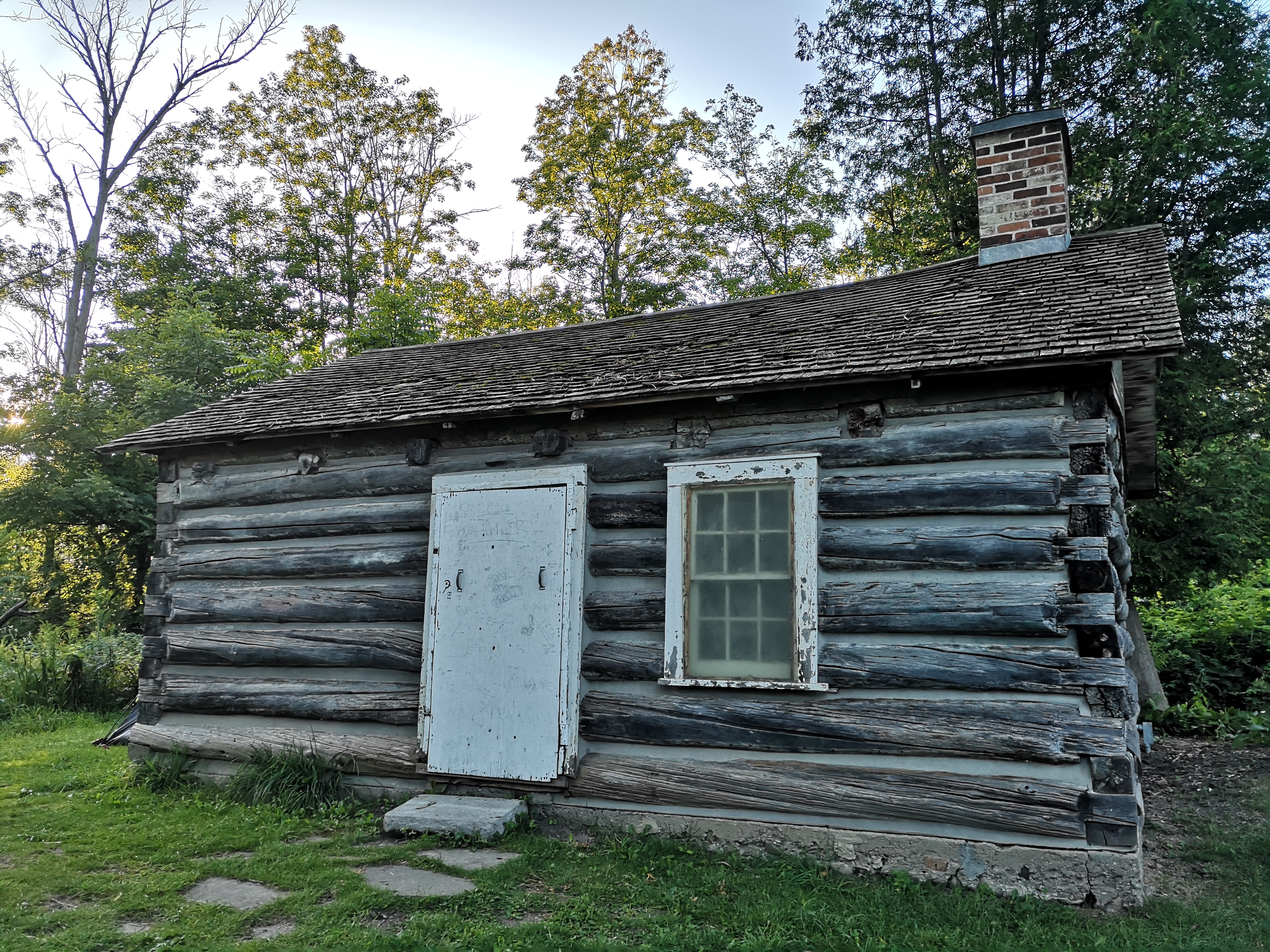
Log construction uses the structural mass of the logs themselves for both framing and insulation. Properly scribed and settled round log walls achieve an effective R-value between R-8 and R-12 per wall — lower than modern assemblies, but log walls add thermal mass that moderates interior temperature swings. Log construction requires skilled scribers and a settling allowance (typically 25–50 mm per metre of wall height) that must be accounted for in door and window framing. The primary advantage for remote sites is that the material — timber — can sometimes be sourced from the site itself with the appropriate cutting permits, reducing transportation cost.
A well-documented 2023 build on Crown land northwest of Cochrane, Ontario used locally milled spruce logs for the shell, reducing bulk material transport to hardware, roofing, and mechanical components only. Total structural material transport weighed approximately 1,400 kg, compared to an estimated 7,000–9,000 kg for an equivalent timber frame build with trucked lumber.
Timber Frame with SIP Infill
A timber frame structure — heavy posts and beams mortised and tenoned together — provides the structural skeleton, with SIPs filling the wall and roof planes. This combination delivers higher insulation values (SIP walls can reach R-28 to R-40 depending on panel thickness) and a faster assembly sequence once the frame is erected. The challenge for remote sites is that SIPs arrive as large panels (typical sheet is 1.2 m × 2.4 m to 1.2 m × 6 m) that are awkward to transport without road access. Several Laurentian builds have used helicopter lift for SIP delivery, with panel sizes cut to maximize load density on lifts.
SIP-Only Construction
Some contemporary off-grid cabin builders use SIPs for both structure and insulation, building without a separate heavy timber frame. This produces a faster, tighter shell but requires precise panel fabrication — errors in the panel cut order are costly to correct on site. SIP-only builds in the 60–90 m² range have been documented with two-person erection teams completing the shell in 5–8 days once panels are on site.
Roofing for Heavy Snow Loads
Roof design for off-grid cabins in Canada must account for ground snow loads that vary from roughly 1.8 kPa in southern Ontario to over 4.5 kPa in parts of northern Quebec and Labrador. The National Building Code of Canada (NBC) provides design ground snow loads by location, but for remote sites not listed, builders typically engage a structural engineer to determine the design load based on regional climate data.
Metal roofing (standing seam or corrugated steel) dominates off-grid builds because of its longevity, low maintenance, and — critically — its ability to shed snow. A metal roof at a 6:12 pitch or steeper will generally self-clear of accumulated snow before structural load limits are approached, reducing the need for manual snow removal that is difficult on remote sites.
Vapour Control in Cold Climates
Moisture management in Canadian cabin construction is more critical than in temperate climates. The large temperature differential between interior and exterior in winter drives vapour from the warm interior toward the cold exterior. If that vapour reaches the dew point within the wall assembly, condensation occurs inside the wall and can cause progressive rot and mould in wood-framed structures.
The standard approach in cold Canadian climates positions a vapour barrier (6 mil polyethylene or an airtight membrane) on the warm side of the insulation — typically between the interior finish and the insulation layer. Air sealing at penetrations (electrical boxes, plumbing, HVAC) is equally important because convective air movement carries far more moisture than diffusion through materials.
Some builders working in zones with extreme cold (below -30°C design temperatures) use a continuous layer of exterior rigid insulation to keep the sheathing temperature above the dew point, effectively eliminating condensation risk within the assembly without relying solely on interior vapour control.
External References
- Ontario Crown Land Use Policy Atlas — Ministry of Natural Resources and Forestry
- National Building Code of Canada 2020 — National Research Council Canada
- BC Crown Land Use Policy — Province of British Columbia